Battery Electric Vehicles (BEV) sales experienced an impressive jump of 32% year-on-year, while Plug-in Hybrid Electric Vehicles (PHEV) sales faced a decline of 13% in comparison. Consequently, the overall EV share of total passenger vehicle sales decreased during the quarter compared to the previous year.
The European market witnessed noteworthy progress in the adoption of Hybrid Electric Vehicles (HEV) and Mild-Hybrid Electric Vehicles (MHEVs), showcasing Europe’s focus on tapping into the lower-end EV market while simultaneously developing battery ecosystems and promoting a circular economy. These initiatives serve as a foundation before placing stronger emphasis on pure EV sales.
The majority of European EV sales during Q1 2023 were dominated by the top five automotive groups: Volkswagen Group, Tesla, Stellantis, Mercedes-Benz, and Hyundai-Kia. Collectively, they held almost two-thirds of the market share. Tesla secured the second position in BEVs, slightly behind Volkswagen. In the PHEV market, Volkswagen led the way, followed by Mercedes-Benz and BMW.
While Chinese EV manufacturers faced challenges in increasing their market share in Europe during the quarter, brands such as MG, BYD, NIO, ORA, and Aiways managed to improve their sales compared to the previous year. However, LYNK & CO, Hongqi, and Xpeng encountered obstacles in the European market. Nevertheless, it is anticipated that Chinese automakers will enhance their market presence in the coming quarters by offering cost-effective vehicles with advanced features, considering the overall expected performance of the EV market.
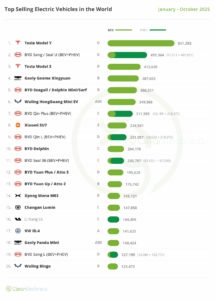
During Q1 2023, the Tesla Model Y emerged as the top-selling EV model, followed by the Volvo XC40, Tesla Model 3, Volkswagen ID.3, and Audi Q4 e-tron. These five models collectively accounted for nearly a quarter of total EV shipments. The Tesla Model Y showcased its dominance across major European countries, illustrating Tesla’s strong brand recognition in the region, except for Spain where it faced stronger competition.
Looking ahead, Counterpoint Research notes that the penetration of EVs in total passenger vehicle sales experienced a decline during the quarter, dropping to 18.4% from 27.6% in Q4 2022. This shift marked a departure from the previous trend of continuous quarterly growth. Factors contributing to this decline included unstable economic conditions and the removal of EV subsidies by Norway. Germany, the largest EV market in Europe, also experienced a decline due to an impending recession and cautious consumer spending that affected the EV market. However, since April, the European region has shown signs of recovery. As a result, it is expected that the share of EVs will rebound and surpass 25% by the end of this year.
Source: Counterpoint Research