In 2022, the European trucking industry contributed a staggering €75 billion to the region’s GDP and supported 577,000 jobs.
Earlier research by BCG has painted a promising picture, forecasting an expected rise to 55% ZEV adoption by 2030 and a more ambitious 77% by 2035. However, regulations are set to play a pivotal role in shaping this transition. The European Commission’s baseline regulation calls for at least 49% ZEV adoption by 2035, while T&E pushes for a more ambitious 97% by the same year.
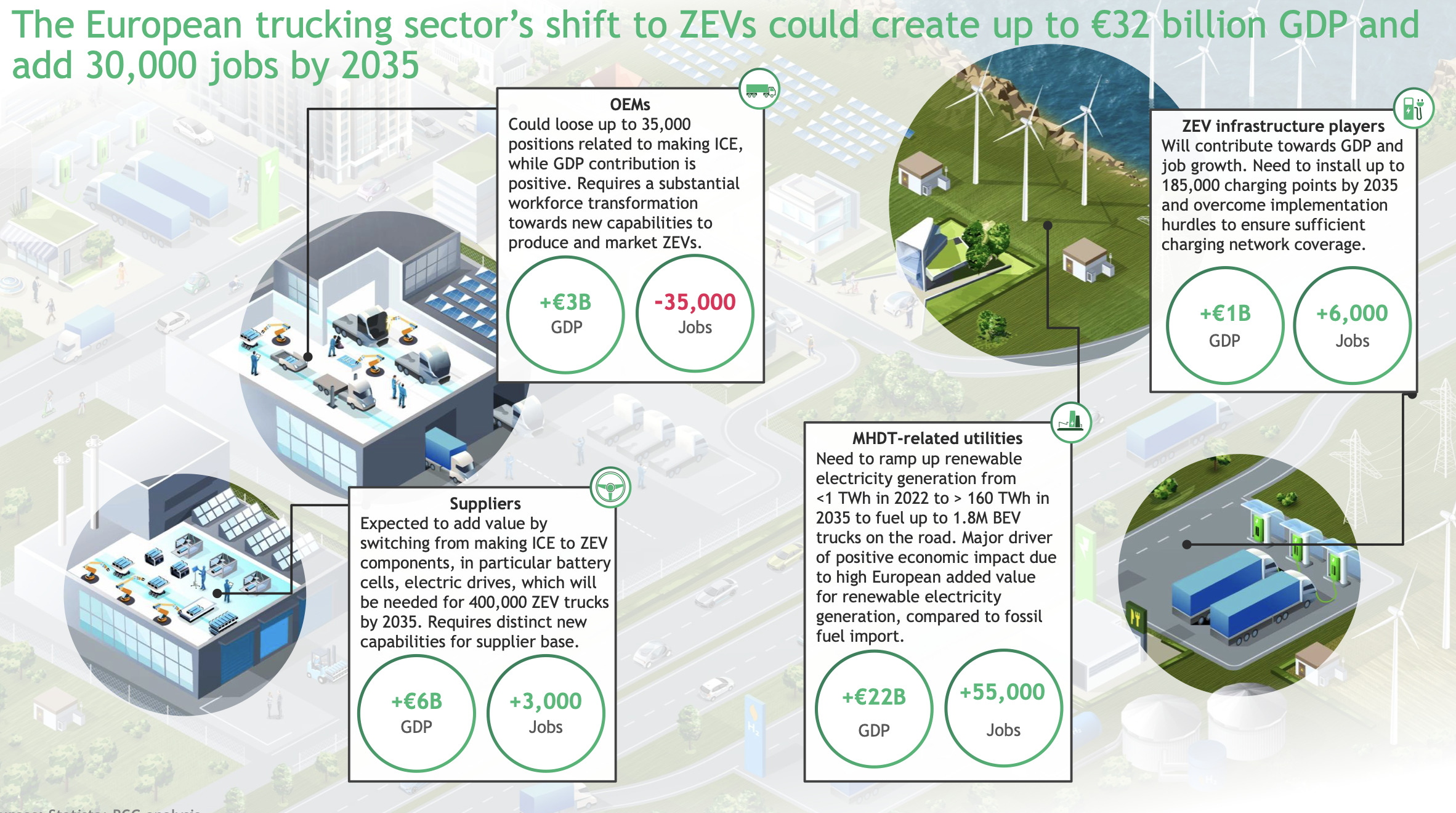
The study delves into the economic consequences of these regulatory scenarios, particularly concerning GDP and employment in Europe. In the T&E case, a shift to ZEVs has the potential to create up to €32 billion in additional GDP and 30,000 new jobs by 2035 compared to 2022. Key drivers of this economic boon include the growth of battery cell production and the shift from imported fossil fuels to domestically generated electricity.
While the shift to ZEVs promises a net positive effect on Europe’s economy, it also ushers in a redistribution of value and jobs. Traditional suppliers and original equipment manufacturers (OEMs) will pivot away from internal combustion engine (ICE) components towards battery cells, electric drive systems, power electronics, and less labor-intensive module packaging.
To position the EU favorably amid these evolving dynamics, certain strategic levers come into play. These include bolstering domestic battery cell production, reskilling the labor force to meet the demands of a changing industry, readying charging infrastructure, and ensuring the affordability of renewable electricity.
The technology shift towards ZEVs opens the door for new foreign players to enter the market. While exports offer a starting point for competition in major markets, localized production becomes essential for long-term dominance. The study acknowledges potential negative impacts on GDP and employment from non-European ZEV players but expects the benefits of transitioning to ZEVs across the entire value chain to outweigh these losses.
In conclusion, the electrification of Europe’s trucking industry presents a remarkable opportunity to align economic prosperity with climate ambitions. It demands strategic foresight, regulatory alignment, and a commitment to technological innovation. As Europe steers towards a more sustainable future, the road to zero emissions may well pave the way for economic growth and job creation.
Source: Impact assessment of the transition to zero-emission trucks in Europe | BCG