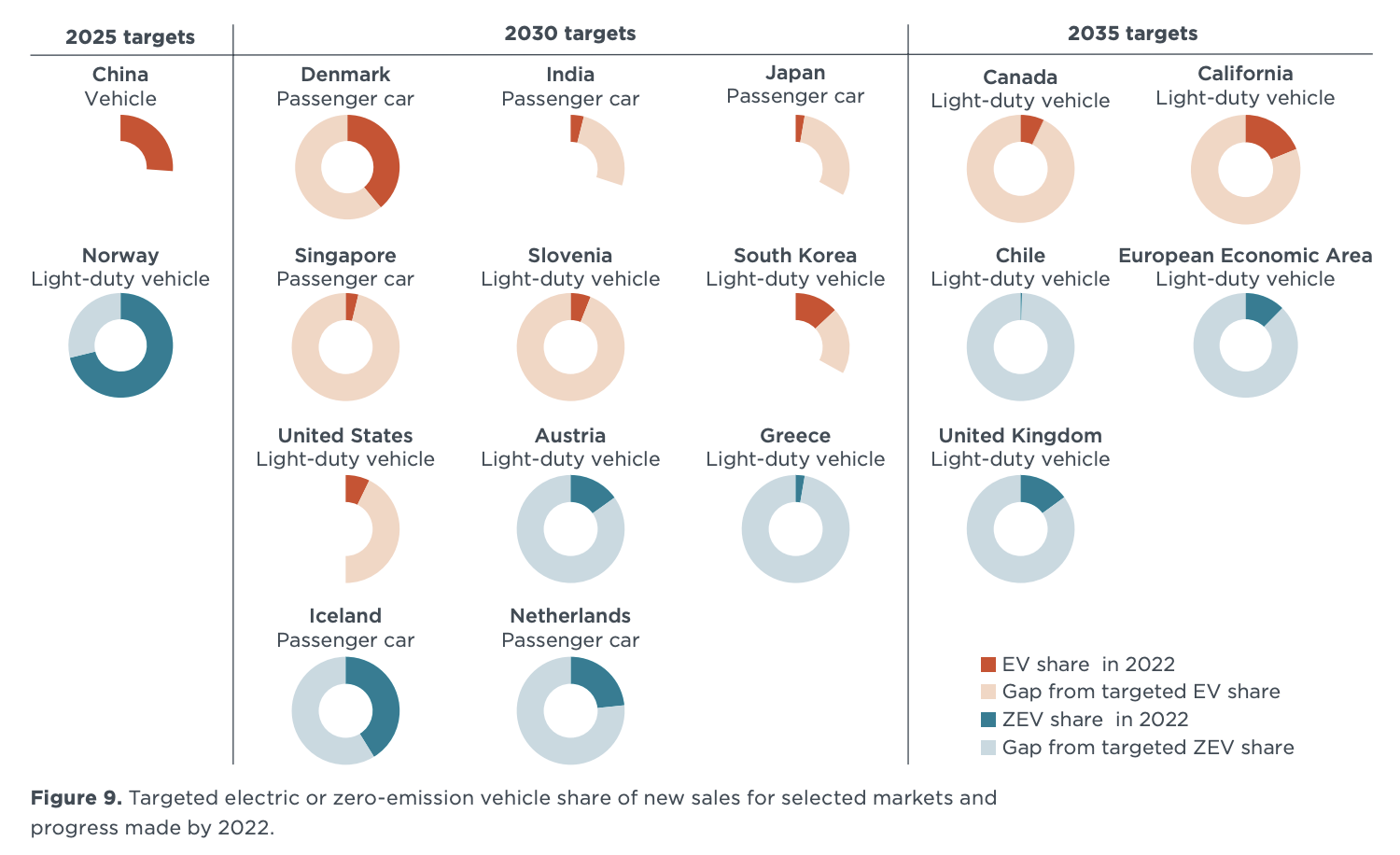
China, the world’s largest automotive market, surpassed its 2025 target of a 20% share of new electric vehicle (EV) sales by reaching an impressive 26% in 2022. This achievement suggests that China may set more ambitious medium- to long-term targets, demonstrating its commitment to sustainable transportation.
Meanwhile, Norway, known for its strong focus on clean mobility, achieved a record-high 71% share of zero-emission vehicle (ZEV) sales in 2022. The country appears to be well on track to achieve its goal of 100% zero-emission light-duty vehicle (LDV) sales by 2025, reinforcing its position as a global leader in the transition to electric mobility.
Denmark and Iceland also showcased promising progress, with an EV share of 39% and a ZEV share of 41% in their respective markets. These figures indicate that both countries are relatively on track to meet their 2030 electrification targets, signaling their dedication to reducing greenhouse gas emissions and promoting sustainable transportation alternatives.
The European Union (EU) recently adopted a regulation mandating zero carbon dioxide (CO2) emissions for new LDVs from 2035 onwards. The regulation applies to the member states of the European Economic Area (EEA), which includes the 27 EU member states and, pending adoption, Iceland, Liechtenstein, and Norway. However, with only a 12% ZEV share of new LDV sales in the EEA, further efforts are required to accelerate vehicle electrification and achieve the ambitious 2035 target of 100% ZEV share in the region.
The ICCT report highlights that several other markets worldwide are also struggling to meet their announced targets for vehicle electrification. While the global push toward a sustainable transportation future is gaining momentum, it is evident that concerted efforts and accelerated actions are needed to overcome the challenges associated with transitioning to electric mobility.
Source: Annual update on the global transition to electric vehicles: 2022 | The ICCT