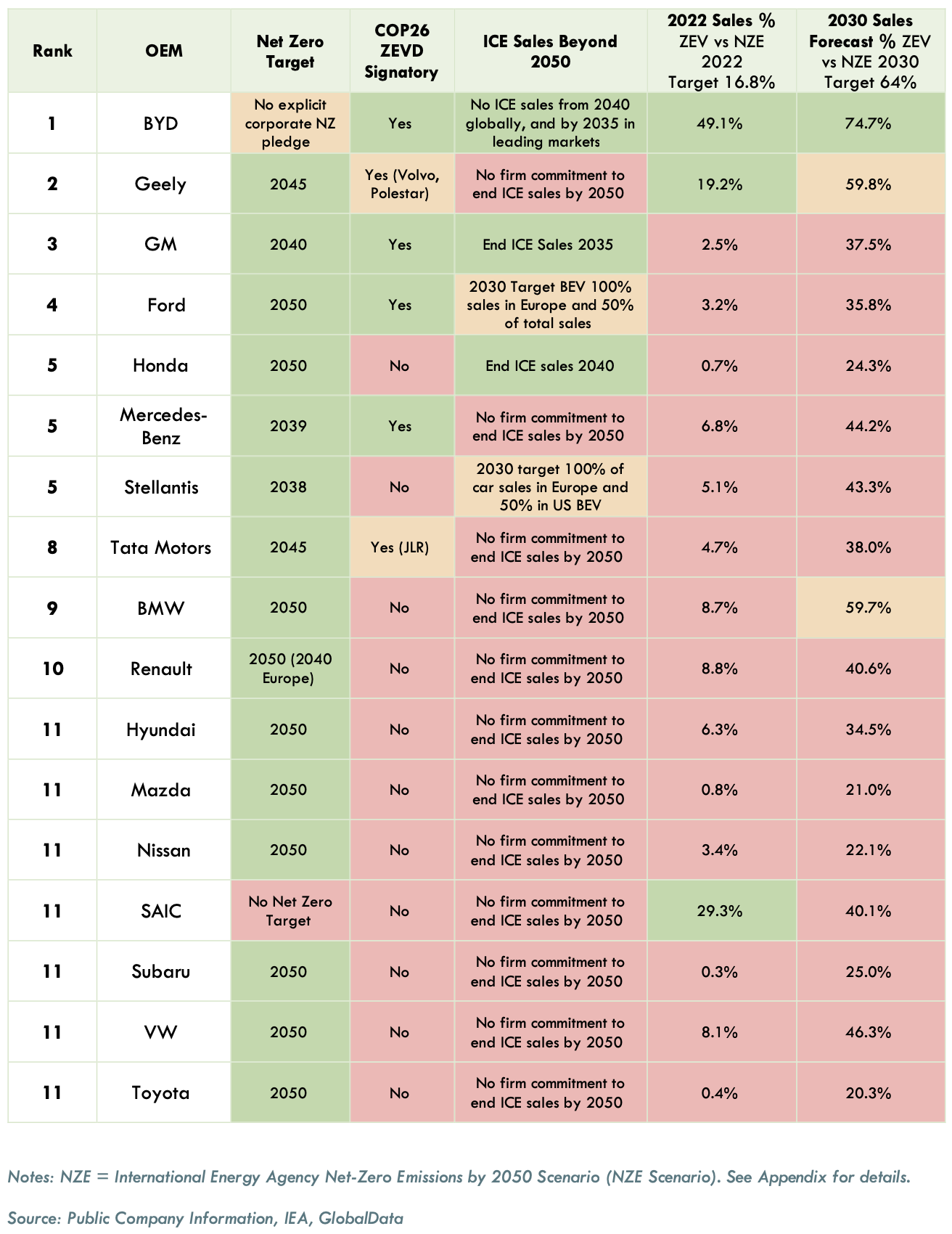
Despite pledges by many leading automakers to align their operations with the goal of achieving net-zero emissions by 2050, the reality of their transition plans paints a different picture. According to the report, the industry is set to continue producing a substantial number of ICE vehicles, contradicting their public commitments to carbon neutrality.
The analysis of OEMs’ net-zero targets and their sales forecasts up to 2030 indicates that even those with a net-zero commitment might still sell up to 64% of passenger vehicles with tailpipe emissions. This translates to over 39 million vehicles with an ICE – a striking contradiction for an industry committed to net-zero emissions before 2050.
Among the OEMs, Chinese producers like BYD and SAIC initially lead the industry in zero-emission vehicle sales. However, forecasts suggest that their momentum in electric vehicle sales could stall beyond 2025, with a significant proportion of their sales still including ICE powertrains. Only BYD is forecast to sell a sufficient proportion of zero-emission vehicles in line with the International Energy Agency’s Net-Zero Emissions Scenario.
The report also reveals that General Motors and Honda have the most aggressive targets to decarbonise their sales, aiming to eliminate tailpipe emissions from new light-duty vehicles by 2035 and to end the sales of gasoline-powered cars globally, respectively. Yet, these ambitious targets stand in stark contrast to the overall industry trend, which is inclined towards maintaining a significant portion of ICE vehicle production.
This discrepancy poses a substantial risk to the global efforts in combating climate change and achieving the 1.5 °C temperature rise limit set by the Paris Agreement. The continued production and sales of ICE vehicles, especially in regions with lax or no decarbonisation targets like the Global South, could undermine global climate goals and lock these regions into a path dependent on fossil fuels.
The Carbon Tracker Initiative’s report serves as a wake-up call for the automotive industry and policymakers worldwide, emphasising the urgent need for stringent vehicle emissions policies and a concerted shift towards electric vehicles to ensure a sustainable and carbon-neutral future.
Source: Driving Change: How Electric Vehicles Can Rise in the Global South | Carbon Tracker Initiative