Currently, the average EV battery range is 326 kilometers, which is more than enough for most drivers’ everyday use as passenger cars travel an average of 45 kilometers per day. However, the remaining 20% of drivers who can’t charge at home or work, as well as long-distance drivers and those in need of a quick top-up, rely on a public network of direct current (DC) fast chargers.
To make EVs a viable option for everyone, the rollout of charging infrastructure must keep pace with the accelerated adoption of EVs. According to EY estimates, 1 million public charge points will be needed by 2025, including at go-to destinations such as shopping centers, as well as over 600,000 workplace chargers. By 2030, this number will increase to 2.8 million public charge points and 2.4 million workplace chargers, requiring around 670,000 new charge points every year, or 13,000 per week.
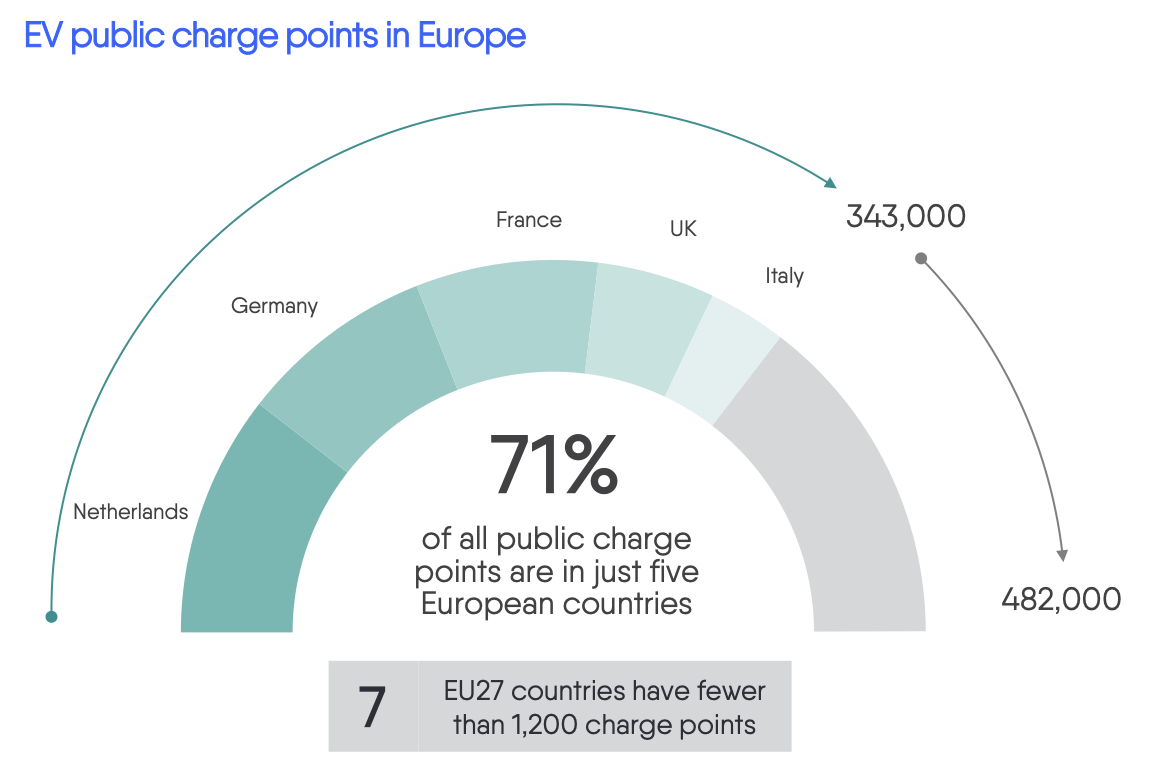
The uneven distribution of charging points is another challenge that needs to be addressed. Five countries, including Germany, France, Italy, the UK, and the Netherlands, account for 71% of all European charging locations.
Removing regulatory barriers, improving access to land for infrastructure, and enabling faster passage via the permitting and processing channels at the local authority level can accelerate the rollout of charging infrastructure. At the utility level, more timely grid connections will support faster rollout.
By 2040, it is estimated that the total number of residential, workplace, and public chargers needed in Europe will top 140 million to service an estimated 239 million EVs. This will require approximately €350bn investment to cover hardware and installation costs, in addition to any grid or distribution system upgrades.
In conclusion, building a public network of EV charging infrastructure is crucial for the full-scale commercialization of EVs. It will require significant investment and efforts from governments, businesses, and communities to make it happen. However, it is a necessary step to make EVs a viable option for everyone, promote sustainable transportation, and contribute to a greener future.
Source: Six essentials for mainstream EV adoption | EY & Eurelectric