This study provides updates to the 2022 study in several significant ways. Firstly, it shifts the policy cutoff from August 2021 to March 2023. Secondly, it expands the regional scope beyond ZEVTC markets and China to model policy developments. This updated study now incorporates ZEV and electric vehicle (EV) targets in ASEAN countries, Latin American countries (excluding Mexico), Australia, New Zealand, South Asian countries (excluding India), and selected markets in the Middle East and Africa.
The global impact of policy developments
The study reveals the impact of various policy developments on cumulative CO2 emissions mitigation between 2023 and 2050. It analyzes policies from 72 countries, accounting for 87% of new vehicle sales globally.
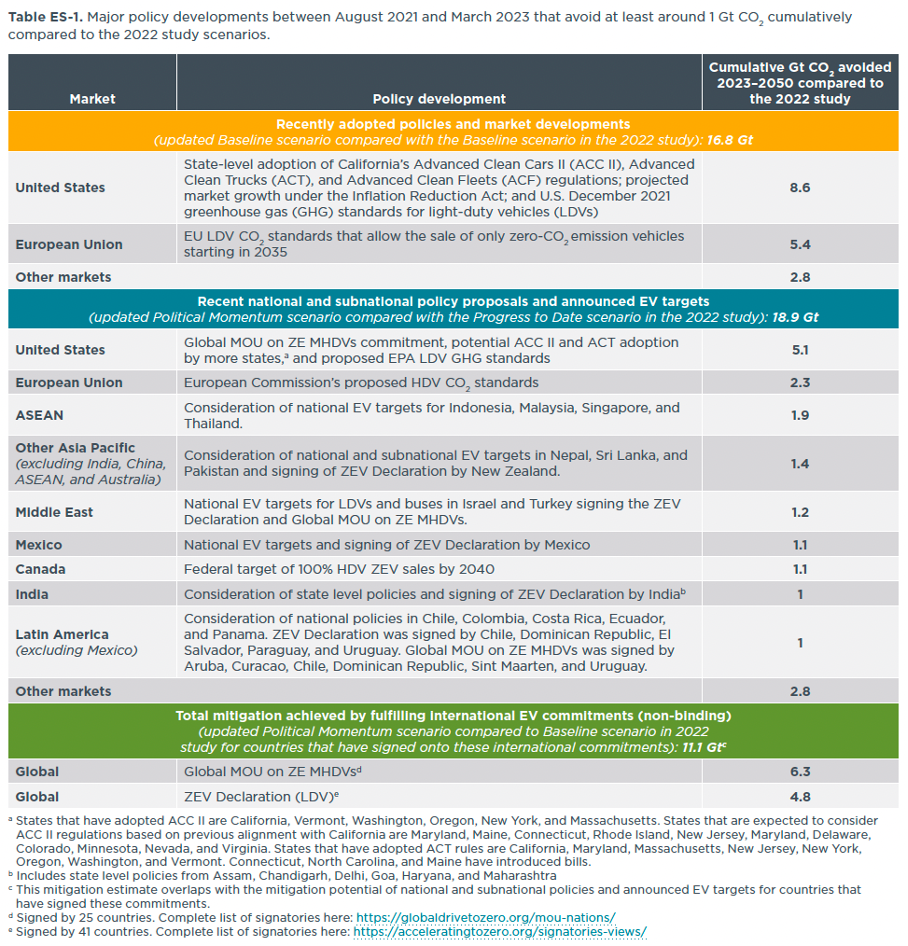
Adopted policies and market developments have the potential to avoid around 17 Gt CO2 emissions from 2023 to 2050. However, if governments follow through on proposed policies and EV targets, an additional 25 Gt CO2 could be mitigated by 2050. The study estimates that international commitments could contribute another 11 Gt CO2 reduction, including region-specific mitigation estimates for signatories.
Acting on proposed policies
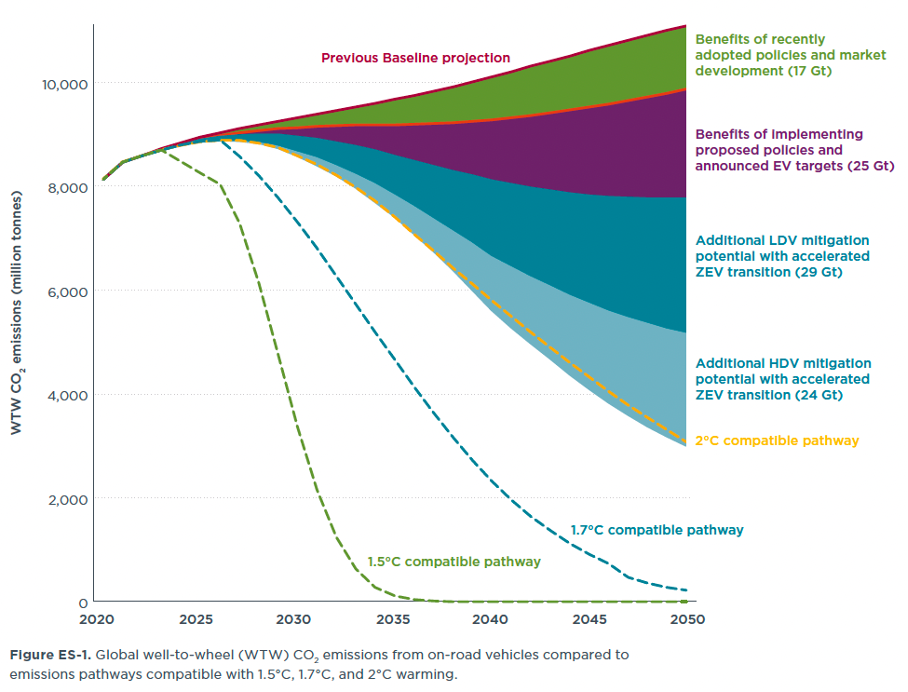
The analysis also provides figures that illustrate projected well-to-wheel CO2 emissions for different policy scenarios. It includes a 1.7°C-compatible pathway in addition to the 1.5°C pathway, emphasizing the increased stringency of sectoral shares.
The results indicate that if only adopted policies are considered, global vehicle CO2 emissions will continue to rise until 2050. However, if governments act on proposed policies and EV targets, emissions could peak by 2030 and remain stable near current levels through 2050. While these actions aren’t sufficient to achieve a below-2°C pathway, there’s potential for further progress with an ambitious ZEV transition scenario.
Some key findings
- The ZEV transition encompasses 72 countries, covering 87% of global new vehicle sales. Recently adopted policies, primarily in the United States and the European Union, have led to an additional 17 Gt CO2 reduction by 2050. Expanding the scenario to include more countries, regions, and policies has the potential to reduce emissions by another 19 Gt CO2.
- The gap between governments’ collective ZEV ambition and a below-2°C pathway has reduced, but further action is needed. While the 2022 study identified a 100 Gt CO2 mitigation potential, announced targets only accounted for about 20 Gt CO2. However, recent policies and proposals have reduced the ambition gap by 34%, with countries like Australia, Canada, the European Union, the United Kingdom, and the United States potentially contributing over half of the global emissions reduction.
- Achieving a global ZEV transition alone may not be sufficient to limit warming to 1.7°C or 1.5°C. Additional actions are required, such as policies to reduce conventional vehicle fuel consumption, promote efficient transportation, and accelerate the adoption of ZEVs. Ongoing research is exploring these options in collaboration with organizations like the International Energy Agency, International Transport Forum, Institute for Transportation and Development Policy, and the United Nations Environment Programme.
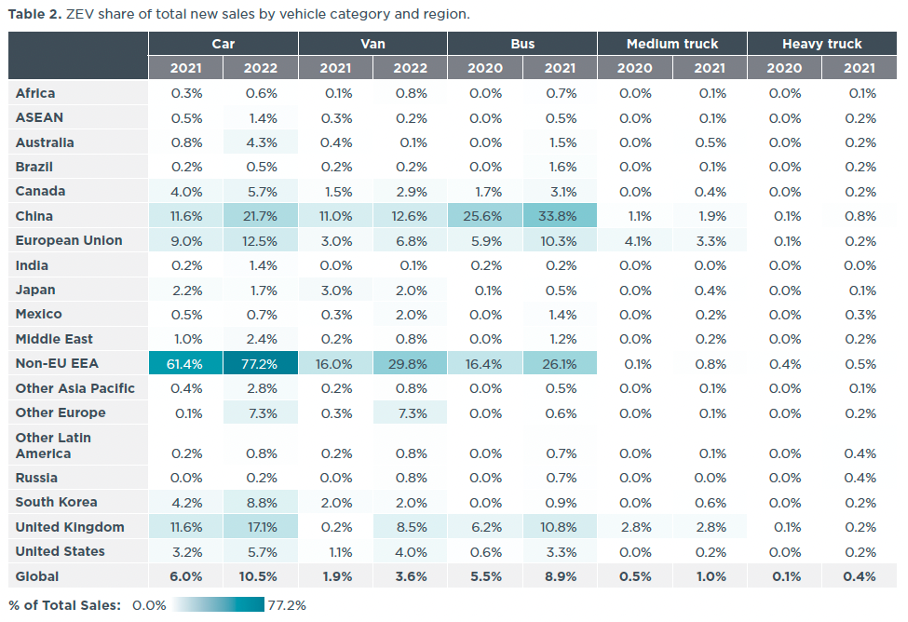
While the gap between current ambition and climate goals has narrowed, further action is needed to achieve more ambitious climate targets and ensure a sustainable and zero-emission future for the transportation sector.
Get ‘free of charge’ access to more than 700 valuable EV Market Insights via www.EVMarketsReports.com, the world’s largest e-Mobility Reports and Outlooks database. Enjoy reading!