AC charging remains strategically important
DC fast charging often attracts the most attention from investors, policymakers and the media. But AC charging remains the foundation of everyday EV adoption.
It is where cars charge at home, at work, in apartment buildings, at depots, at hotels and in semi-public parking environments. As EV adoption moves further into the mainstream, AC charging is becoming more sophisticated. Buyers are no longer only looking for a wallbox. They increasingly expect smart charging, load balancing, solar integration, fleet reporting, payment functionality, tariff optimisation and integration with wider energy systems.
Evolving beyond the traditional hardware model
AC charging is therefore also moving beyond the traditional hardware box model. For manufacturers, the market is no longer only about producing and shipping chargers at scale. Software, connectivity, smart charging, energy management, dynamic load balancing, solar integration, tariff optimization, and fleet reporting are increasingly becoming part of the proposition. This opens additional revenue pools around software subscriptions, energy services, maintenance, data, load management and integration with wider home, building and fleet energy systems.
Not one AC market, but several
LCP Delta’s segment data shows why the market should not be interpreted as one single category.
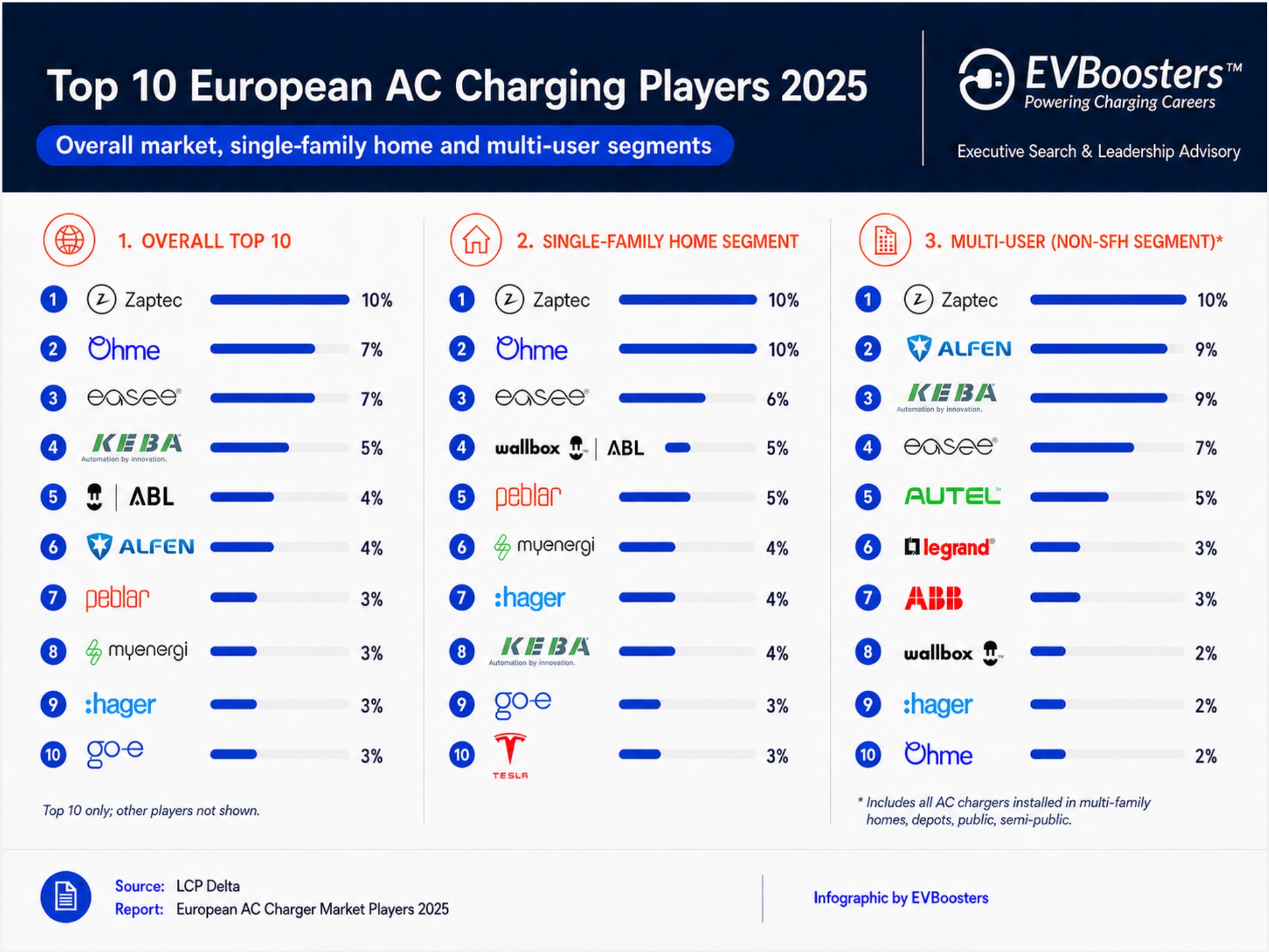
In the single-family home segment, Zaptec and Ohme both lead with 10%, followed by Easee at 6%. In the multi-user AC segment, including multi-family homes, depots, public and semi-public sites, Zaptec again leads with 10%, followed by Alfen and KEBA at 9%, and Easee at 7%. That distinction matters. Winning in single-family homes requires a different go-to-market model from winning in apartment buildings, fleet depots, public tenders or semi-public commercial locations.
Zaptec’s strong position is being challenged
Zaptec retains a strong position in the European AC charger market, supported by its distinctive product design, reliability and strong performance in several core markets. With a 10% market share in LCP Delta’s 2025 data, the company remains the overall market leader.
But Zaptec is increasingly being challenged by a group of serious competitors, including Ohme and Easee. Ohme stands out through its strength in the UK residential market, where it holds the number one position. Easee, however, is particularly interesting because of its broader European footprint.

In LCP Delta’s 2025 data, Easee is joint second overall with Ohme, with both companies holding 7% of the total European AC charger market. Easee also holds 6% in the single-family home segment and 7% in the multi-user segment, which includes multi-family homes, depots, public and semi-public AC charging.
Compared with LCP Delta’s earlier home charging benchmark (2024), Easee appears to show steady growth in its core markets. The company ranks among the top three AC charger players in Scandinavia, the Benelux and several other markets where it is active. That makes Easee more than a former residential challenger. It is becoming one of the few AC players with a credible position across multiple use cases and multiple European markets.
7 out of 12 local champions dominate at country level
The most revealing insight is at country level. LCP Delta lists 12 country leaders: Ohme in the UK, Elli in Germany, Hager in France, Peblar in the Netherlands, Zaptec in Norway, Alfen in Belgium, Wallbox in Spain, Zaptec in Sweden, KEBA in Denmark, Easee in Switzerland, Free2move eSolutions in Italy and go-e in Austria.
On a strict home-market interpretation, 7 of these 12 country leaders are domestic players. That means 58% of the listed national market leaders come from the country where they hold the number one position.
This supports a broader conclusion: Europe is not one AC charger market. It is a collection of national and regional markets shaped by installer networks, housing stock, grid rules, subsidy schemes, utility partnerships, company-car structures, local procurement and consumer trust.

Why international expansion in AC Charging remains hard
After more than a decade of EV charging growth, it remains difficult for most AC charger manufacturers to enter a new country and quickly establish a leading position. The reason is clear: AC charging is not only a hardware business. It is a local execution business.
A manufacturer can have a strong product, competitive pricing, and a credible European ambition, yet still struggle to gain traction if the local commercial engine is not in place. In AC charging, market access is shaped by electricians, wholesalers, utilities, leasing companies, housing associations, fleet customers, CPOs, real estate owners and energy partners. These relationships are built over years, not quarters.
That makes go-to-market fit by country just as important as product-market fit. Building a position in a new market requires more than appointing a distributor or hiring a first sales lead. It requires local credibility, installer access, regulatory understanding, service capability and leadership that can translate a European strategy into country-level execution.
For leadership teams, investors, and market observers, this is one of the most important messages behind the data. Scale matters, but local channel access, trust, and execution capacity often matter more than expected.
Building and retaining strong local leadership teams

The required leadership style also depends on the stage of the local organization. A market-entry phase may require a hands-on country builder. A post-traction phase may need a structured commercial leader who can build a repeatable sales engine. A fragmented local team may need someone who can create alignment. A mature market may require leadership that improves accountability, execution rhythm and collaboration with HQ.
This is how we (EVBoosters) approach these challenges: not by starting with a generic job title, but by first mapping the market phase, local commercial model, organizational gaps, and required team structure.
The challenge ahead
To conclude, the winners in the next phase will not simply be the companies with the best hardware. They will be the players that combine product quality with installer loyalty, software capability, energy management, local service coverage, software revenue models, data capability, energy partnerships, and the leadership capacity to scale internationally without losing local relevance. Hence, Europe’s AC charger market is large, growing, and highly competitive. But it is still far from won.
Since 2018, EVBoosters Executive Search has supported companies in EV charging and e-mobility with building the leadership and local teams needed to scale across European markets, from country managers and commercial leaders to operational, product, executive and board positions.
About the author

This article was written by Paul Jan Jacobs, Managing Partner and Founder of EVBoosters Executive Search. Active in the European e-mobility and EV charging market since 2010, Paul Jan regularly writes about the charging industry and its impact on leadership, organization building, and executive talent.
Are you interested in strengthening your leadership team? Get to know Paul Jan and explore how EVBoosters Executive Search can support your company’s next phase.
Source and methodology
The data is based on LCP Delta’s AC charger market share research, using 2025 unit sales volumes shared by AC charger manufacturers. The figures cover AC chargers sold across Europe, including residential and non-residential segments. Market share is measured by units sold, not revenue or installed base.