The powertrain hierarchy is starting to change in Europe
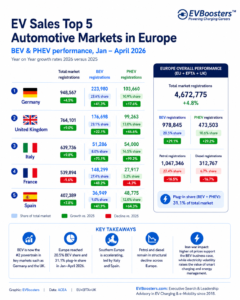
The market data support this next development phase. In 2025, electric car sales in Europe, including BEVs and PHEVs, reached 4.2 million vehicles, or 28% of all new cars sold. In the EU, BEVs alone reached 1.88 million registrations and 17.4% market share.
Momentum continued into 2026. In the first four months of 2026, BEVs reached 20.5% across EU, EFTA and the UK, while plug ins reached 31.1%. In Germany and the UK, BEVs moved ahead of petrol. This is an important signal. The market is not only growing in volume, the powertrain hierarchy is starting to change.
Charging infrastructure is scaling as well. EVBoosters’ latest market update, powered by EAFO data, showed that Europe reached approximately 1.3 million public charging points by April 2026. The real buildout is still ahead. The IEA expects the EU public charger stock to reach around 2 million public charging points by 2030 and roughly 3.5 million by 2035. Across Europe as a whole, the public charging network is expected to grow to more than 4.3 million public charging points by 2035.
The conclusion is clear. Europe does not only need more chargers. It needs better located, better operated and more reliable charging infrastructure, managed by companies that understand both mobility demand and energy system complexity.
Eight major financing deals by announced facility size
The infographic above shows eight selected debt, green loan, and infrastructure financing deals announced since January 2025 until May 2026. They are not intended as a complete market ranking, but as a representative view of where institutional capital is moving in Europe’s CPO landscape. Below, we examine what each transaction reveals about the next phase of EV charging infrastructure.
Up to €600m green loan facility, IONITY
The largest transaction in this selection shows that strategic high-power charging corridors are now being financed as long-term infrastructure. IONITY is positioned around pan-European ultra-fast charging along key travel routes, backed by major automotive shareholders. The scale of the facility indicates that lenders are becoming more comfortable with corridor-based charging infrastructure when the platform has strategic relevance, strong shareholders, and a clear growth plan.
Up to €433m green loan facility, Electra
This transaction marks an important milestone for one of Europe’s fastest-growing ultra-fast charging platforms. Electra’s green loan facility of up to €433 million brought its total funding raised since inception to over €1 billion. The deal shows how urban and destination-based fast charging platforms can move from venture-style expansion to bankable infrastructure financing, provided they can demonstrate scale, demand, and execution capability.

€350m investment facility, Believ (£300m)
Local public charging infrastructure is also attracting large-scale capital. Believ secured a £300 million investment facility to install at least 30,000 public charge points across the UK. The deal is different from the high-power charging platforms in this overview. Success depends on long-term partnerships with local authorities, public sector organizations, grid operators, and communities, especially for drivers without private parking.
€293m debt financing, InstaVolt (£250m)
A proven rapid charging model can now attract significant structured capital. InstaVolt secured £250 million in committed debt financing to support the expansion of its network across the UK and Ireland. The company’s investment case is built around strong site partnerships, reliable public charging, and operational maturity. For lenders, the attraction lies in site quality, growing utilization, network performance, and the ability to turn capital into productive charging assets.
Up to €200m green financing, Fastned
Fastned’s financing underscores the growing bankability of repeatable fast-charging station formats. The company secured up to €200 million in green financing, including committed capital for Belgium and Switzerland, as well as an accordion option for other markets. Its recognizable station format and focus on high-traffic locations make Fastned one of Europe’s most visible fast-charging specialists. The deal suggests growing lender confidence in cross-border rollout models with clear asset logic.

Up to €138m green debt financing, GreenWay
This transaction sends a different signal than the Western European fast-charging deals. GreenWay’s financing shows that institutional capital is moving into Central and Eastern Europe. The facility supports fast and ultra-fast public charging infrastructure in markets such as Poland, Slovakia, and Croatia. GreenWay should not be seen purely as a corridor player. It is a regional CPO and e-mobility platform that helps build infrastructure in less-mature but strategically important growth markets.
€129m senior debt facilities, Osprey Charging (£110m)
The UK rapid charging market continues to attract infrastructure finance. Osprey Charging secured £110 million in senior debt facilities to support super-fast charging hubs across prime UK locations. The transaction reflects the growing bankability of operators with proven sites, strong network performance, and operational maturity. For lenders, the key question is no longer only rollout speed. It is whether each site can deliver reliability, user experience, and long-term asset productivity.
€120m financing facility, Milence
Dedicated heavy-duty charging is moving into a more structured financing phase. Milence signed a €120 million financing facility to support the rollout of high-performance truck charging hubs across Europe. Backed by Daimler Truck, TRATON GROUP and Volvo Group, the company has a strong industrial base. The deal points to growing confidence in truck charging infrastructure, where capital intensity, operational complexity, and freight decarbonization create a very different investment profile.
From charge point operators to energy infrastructure platforms
The role of CPOs is changing fundamentally in the years to come. The strongest operators are no longer simply installing, owning, and maintaining charge points. They are becoming energy infrastructure platforms, responsible for grid access, uptime, pricing, energy procurement, load management, battery storage, renewable energy integration, and customer experience.
This shift changes the economics of the business. Charging revenue remains important, but it is no longer the only value stream. CPOs that manage energy well can create additional value in several ways. Dynamic pricing can improve margins. Peak shaving and battery storage can reduce grid costs. Demand response and grid balancing can create flexibility value, where regulation allows. Renewable energy optimisation and energy trading can further strengthen the business case.
That makes energy capability a strategic differentiator. In a market shaped by grid congestion, volatile power prices, and rising utilization, the winners will not simply be the operators with the most charge points. They will be the companies that can turn charging sites into flexible, reliable, and commercially productive energy assets.
In the next phase, CPOs will be judged less as rollout companies and more as critical infrastructure operators.

What the financial sector is really validating
The common denominator across these deals is not only confidence in EV adoption. The financial sector is starting to validate EV charging as an infrastructure asset class.
That is an important step. Earlier EV charging growth was often funded by venture capital, strategic shareholders or public incentives. The latest transactions show that banks, infrastructure lenders, public finance institutions, and long-term investors are becoming more comfortable with selected CPO business models.
This does not mean every operator will have easy access to capital. It means that the strongest platforms can now demonstrate enough maturity, asset quality, pipeline visibility, and operational performance to attract structured financing.
Debt is especially important. It brings discipline into the sector. It requires stronger reporting, better governance, more accurate forecasting, professional asset management, and a clearer view of risk. That is positive for the long-term development of the market, but demanding for leadership teams.
For boards and investors, this also changes the conversation. The question is no longer only whether a CPO can win new locations. It is whether the company can build a repeatable operating model, manage capital intensity, handle grid delays, and prove that utilization can develop into sustainable returns.
From financing to leadership and organizational transformation
The companies attracting this level of capital are entering a different organizational phase. The challenge is no longer only about raising money or securing early locations. The challenge is to turn capital into reliable infrastructure at scale.
That requires stronger country organizations, more mature operations teams, better grid and energy capabilities, professional finance functions, structured site acquisition teams, and commercial leaders who can work with investors, municipalities, landlords, fleets, and strategic partners.
In the early phase, speed and entrepreneurial energy were often enough. In the next phase, execution quality becomes the differentiator. A company that can manage 100 sites is not automatically ready for 1,000 or even 10,000. A founder led team that performs well in one market may need a different structure to handle the complexity of operating across multiple countries.
Behind every major financing round is a leadership and organization question. Capital is only useful when a company can deploy it well. The leadership team needs to evolve with the business model, capital structure, and expectations of financial institutions and investors.
This is where growth, restructuring, and transformation become part of the same conversation. Not because the early team failed, but because the company has entered a new stage.
Since 2018, EVBoosters’ Executive Search & Leadership Advisory has supported charging companies across the European EV charging sector on growth and transformation challenges at both the organizational and leadership levels. When the right structure, leadership requirements, and critical capabilities are clear, this can be followed by a targeted executive search for the leaders needed to make the next phase successful.
For more information about how we can help your company through its next growth phase, contact Paul Jan Jacobs.